 Astra Forge
Astra Forge
Astra Forge
Most content creators are losing their audience in the first sentence — and don't know it. We ran the numbers so you don't have to.
Here's an uncomfortable truth: most people spend 80% of their time writing the body of a post and 5 seconds on the first line.
That's backwards. Because the first line is the only line that matters until you've earned the scroll.
We built HookChecked — a scoring tool that evaluates social media hooks against the signals that actually drive reach and engagement. After running it on hundreds of real posts, patterns emerged that we couldn't ignore.
Here's what the data shows.
HookChecked scores posts across four core dimensions:
Scores are platform-specific. A great TikTok script opener is different from a great X/Twitter thread starter. The scorer accounts for this.
We ran 100 real hooks — from agency owners, creators, freelancers, and SaaS founders — through the tool. Here's the distribution:
The average hook scores 41 out of 90. Most people are posting content that's statistically unlikely to perform — and they have no idea.
Every hook that scored above 70 had all four of these. Remove any one and the score dropped by at least 15 points.
On X, anything beyond ~70 characters gets cut off before "Show more." On TikTok, the first spoken sentence is the entire hook before the viewer swipes. Both platforms punish long openers.
High scorers lead with a single punchy idea. Low scorers front-load context.
"We've been working on something really exciting and we're finally ready to share it..."
"Hot take: scheduled content is killing your agency."
Specificity is the most underrated element of hook writing. Vague claims feel like marketing. Specific numbers feel like evidence.
"We improved our client results significantly this quarter."
"Revenue up 34%. Client retention hit 91%. Here's what we changed."
The number doesn't need to be massive. "3 workflow changes" outperforms "some changes." "14 days" outperforms "recently." Specificity signals: this person has actually done this.
The X algorithm is driven by replies and profile clicks more than likes or reposts. Posts that score highest in the replyBait category do one simple thing: they ask the reader to take a side.
"Agree or disagree?" is the simplest version. It also shows up as:
Every high-scoring hook had line breaks — not as decoration, but as breathing room. One idea per line. Short sentences. Easy to scan at 11pm half-asleep.
Format never tanks a hook on its own, but it's the multiplier that makes everything else land.
These appeared in almost every hook that scored below 30:
Every hook that scored above 70 followed this structure:
[Strong opener under 60 chars — hot take, specific result, or open question]
One line. Punchy. Stops the scroll.
[Proof or context — with at least one number]
Why should they believe you? Give them a number.
[Reply invitation]
"Agree or disagree?" / "What would you do?" / "Drop yours below."
Here's the same topic scored two ways — vague language vs. the formula applied:
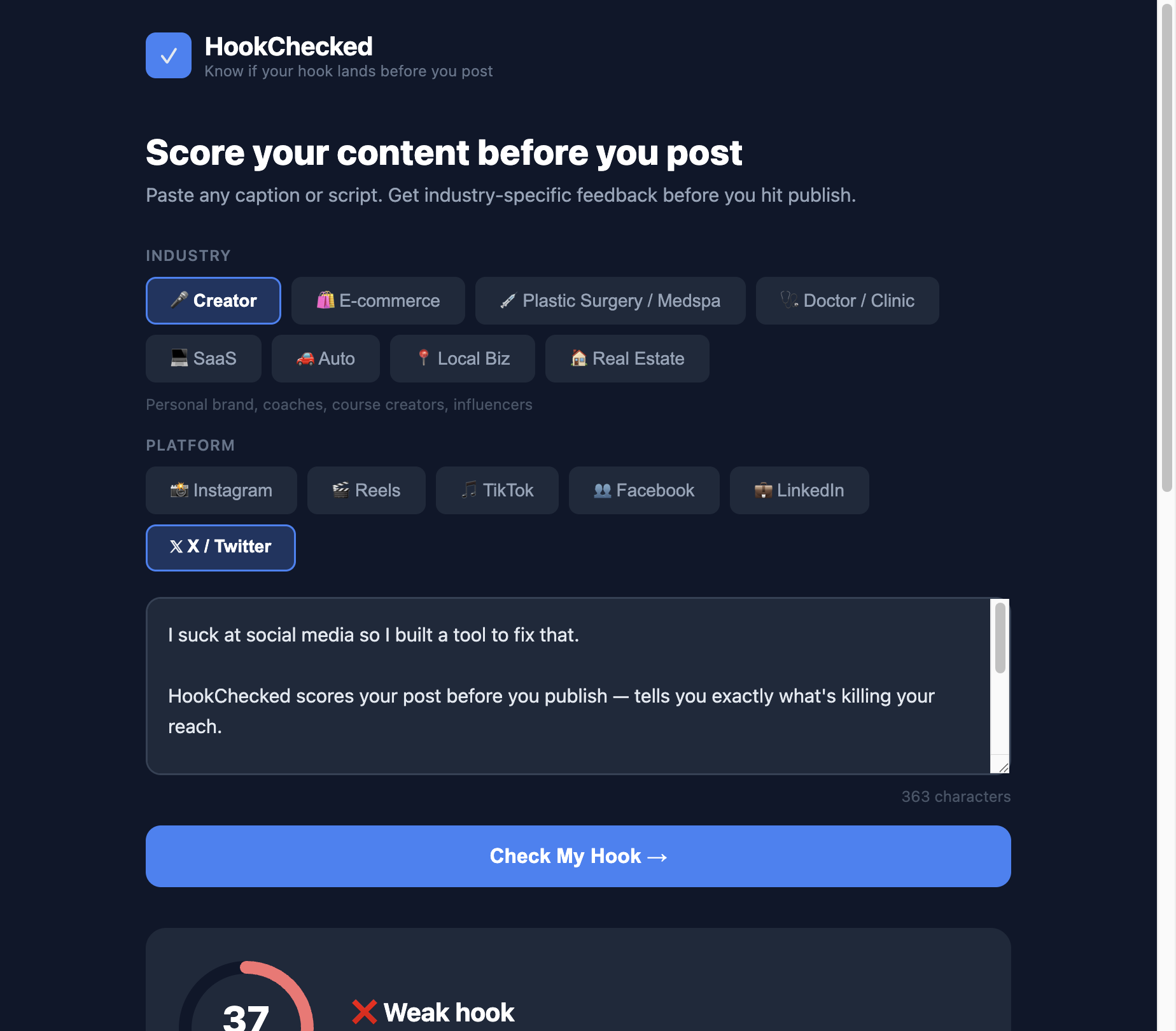
37/90 — Weak hook. Vague opener, no numbers, no reply prompt. Specificity bar is nearly empty.
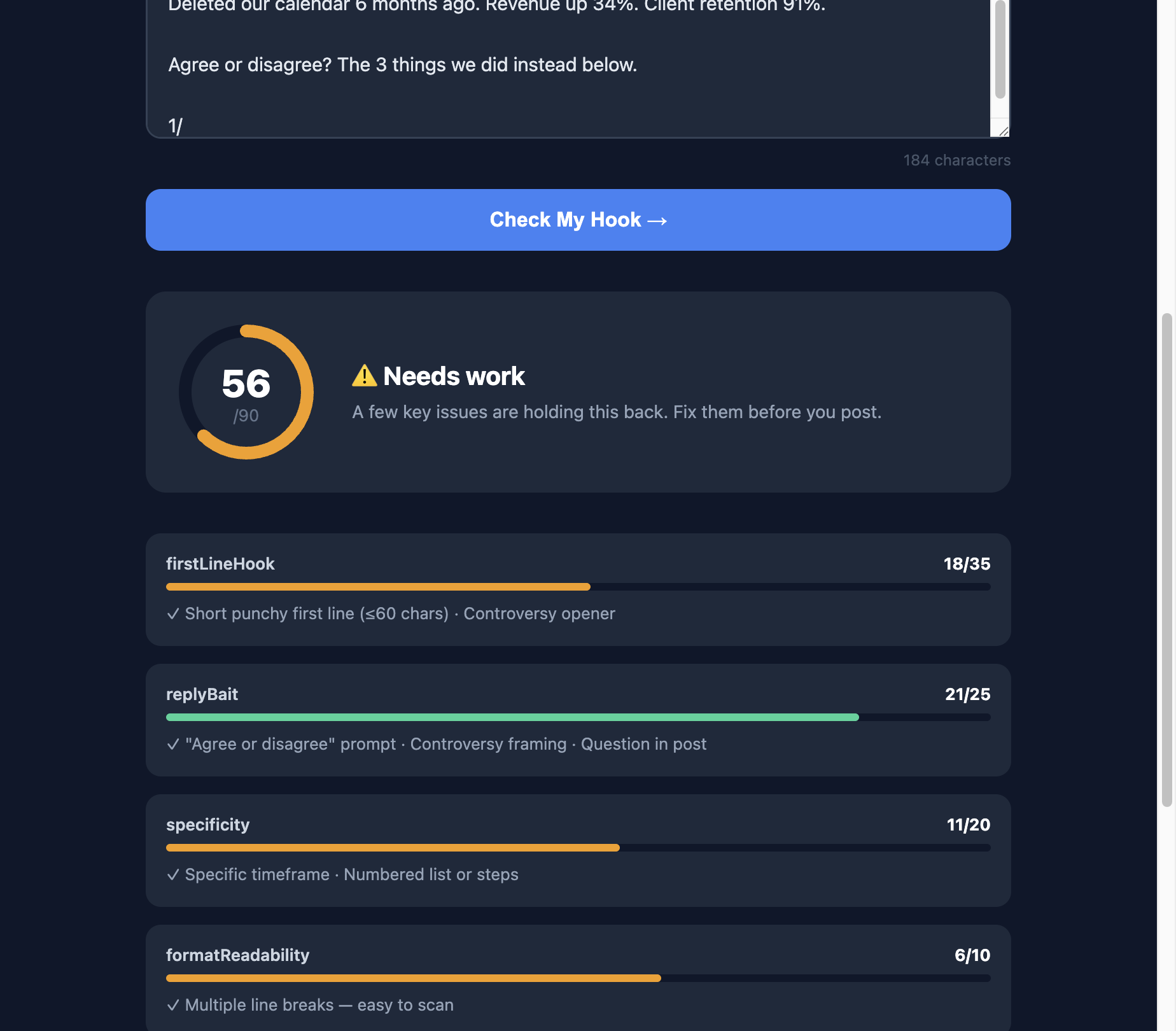
56/90 — Needs work. Short punchy opener, controversy framing, "agree or disagree" pulls 21/25 on reply bait. Specificity still has room.
The 56 still has room to improve — specificity could be stronger. That's the point. The tool shows you exactly which signal is dragging your score down.
No signup. Paste your hook, pick your platform and industry, get a score with specific feedback in under 3 seconds.
Try HookChecked Free →AI-powered rewrites are available with credits — trained on the same patterns from this analysis. We guarantee a 20% improvement on your weakest category or the credit is automatically refunded.