TikTok Captions Don't Matter — We Analyzed 40 Viral Posts to Find What Actually Does
We built a content scoring tool. To make it accurate, we had to collect real data — viral posts, low-performing posts, and everything in between — and figure out what actually separates a 44M-view TikTok from a 300-view one.
We scored 40 posts across TikTok, Instagram Reels, Instagram captions, Facebook, and LinkedIn. We transcribed real videos. We ran backtests. Here's what we found.
Finding #1: TikTok captions are irrelevant
This was the biggest surprise. When we scored TikTok captions the same way we scored Instagram captions, our model was only 30% accurate. We kept predicting low performance on videos that hit millions of views.
The reason: TikTok captions are a label, not content. Nobody reads them before deciding to watch. The video autoplays. The first 3 seconds of audio — the verbal hook — is what drives watch time, shares, and reach.
Once we switched to scoring the transcript (the actual words spoken in the first 10-30 seconds), accuracy jumped to 88%.
Takeaway: If you're optimizing your TikTok captions, you're working on the wrong thing. Optimize your opening line — the first sentence you say out loud.
Finding #2: There are 5 TikTok archetypes that actually go viral
After transcribing and analyzing 10+ viral TikToks, a clear pattern emerged. Nearly every high-performing video fell into one of five archetypes:
⚡ Controversy + Tutorial
Opens with a hot take or challenge, then delivers step-by-step value. Creates debate while educating.
🔥 Debate / Hot Take + Punchline
States a strong opinion, builds the argument, lands with a memorable close. Drives comments and shares.
🎯 Curiosity Gap + Conflict
Opens with an incomplete statement that creates tension. Viewer has to watch to resolve it.
🕵️ Expose the Lie + Authority
"What [authority] doesn't want you to know." Positions creator as insider with suppressed info.
🌀 Chaos Spiral + Deadpan
Starts with minor problem, escalates to disaster, delivered with flat affect. Pure entertainment loop.
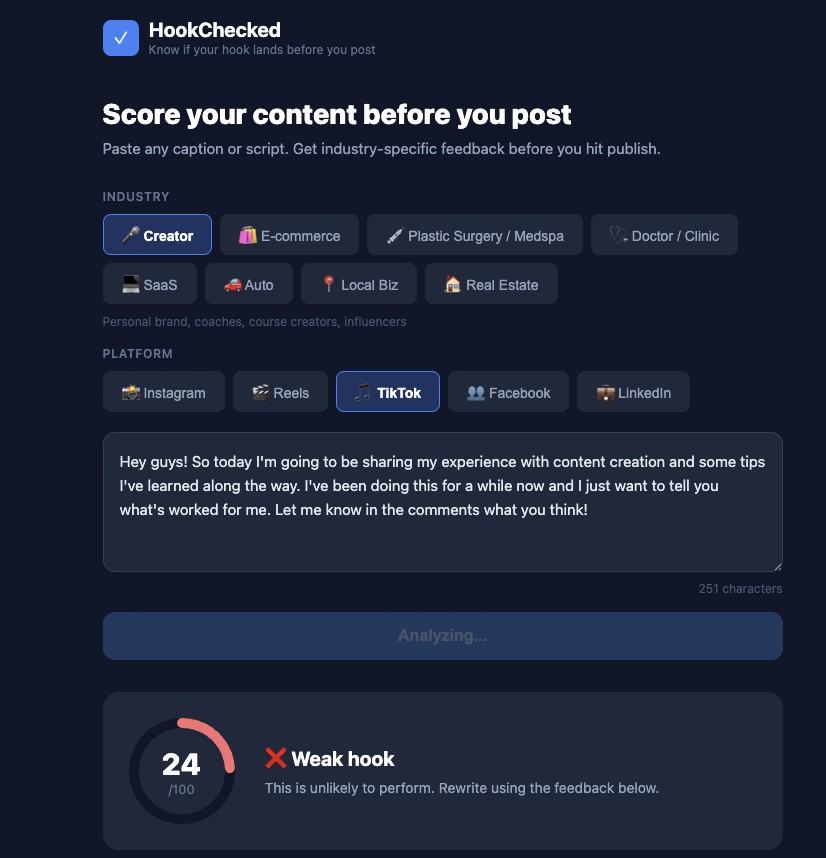
The lowest-performing videos we analyzed shared a different pattern: they opened with process instead of conflict. "So today I'm going to show you..." is a death sentence on TikTok.
Finding #3: The death patterns are specific and avoidable
We identified the exact phrases that consistently appeared in low-performing TikTok content:
- "So let's give this a try..."
- "Now we're going to talk about X..."
- "I just want to tell you my experience with..."
- "Hi guys, welcome back to my channel..."
- "Today I'm going to show you how to..."
What do these have in common? They're all process-first. They announce what's about to happen instead of creating a reason to keep watching. The audience hasn't been given anything to want yet.
- "What your doctor doesn't tell you about sunscreen 🧴"
- "Before and after your first Botox appointment (realistic expectations)"
- "What $500K buys in different US cities 🏠"
- "Never pay sticker price at a dealership again. Here's exactly what to say."
These openers are all result-first or conflict-first. They create a gap the viewer needs to close. The watch time follows automatically.
Finding #4: Instagram Reels and TikTok are completely different platforms
This matters for agencies managing content across both. The viral archetypes that work on TikTok don't automatically translate to Reels — and using the wrong format kills performance on both.
| Dimension | TikTok | Instagram Reels |
|---|---|---|
| Energy | Chaotic, raw, unpolished | Cinematic, produced, intentional |
| Best opener | Conflict or hot take | Result or transformation |
| Trust signal | Personal story + authenticity | Visual quality + journey narrative |
| CTA style | Implicit ("follow for part 2") | Explicit save/share request |
| Death pattern | Process-first opener | Chronological backstory |
The highest-performing Reels we analyzed opened with the result first — then went back to explain how it happened. The lowest-performing started from the beginning and worked forward chronologically. Audiences don't have patience for buildup anymore.
Finding #5: Facebook algorithm actively suppresses spam signals
Facebook and Instagram have very different spam detection. Facebook aggressively suppresses posts with:
- All-caps phrases (4+ capitalized words)
- Excessive exclamation marks (3+ clusters)
- Clickbait framing ("doctors don't want you to know")
- Promo spam openers ("🔥 FLASH SALE 🔥 50% OFF!!")
In our dataset, a flash sale post with these signals scored high on value markers (discount language, urgency, CTA) but got suppressed in real distribution. Our early scorer missed this entirely until we hard-capped scores for posts with 4+ spam signals.
Facebook's highest-performing content is short, emotionally resonant, and debate-worthy. "Agree or disagree: most people overcomplicate their morning routine." That format drives more reach than any promotion ever will.
Finding #6: Series content plays by different rules
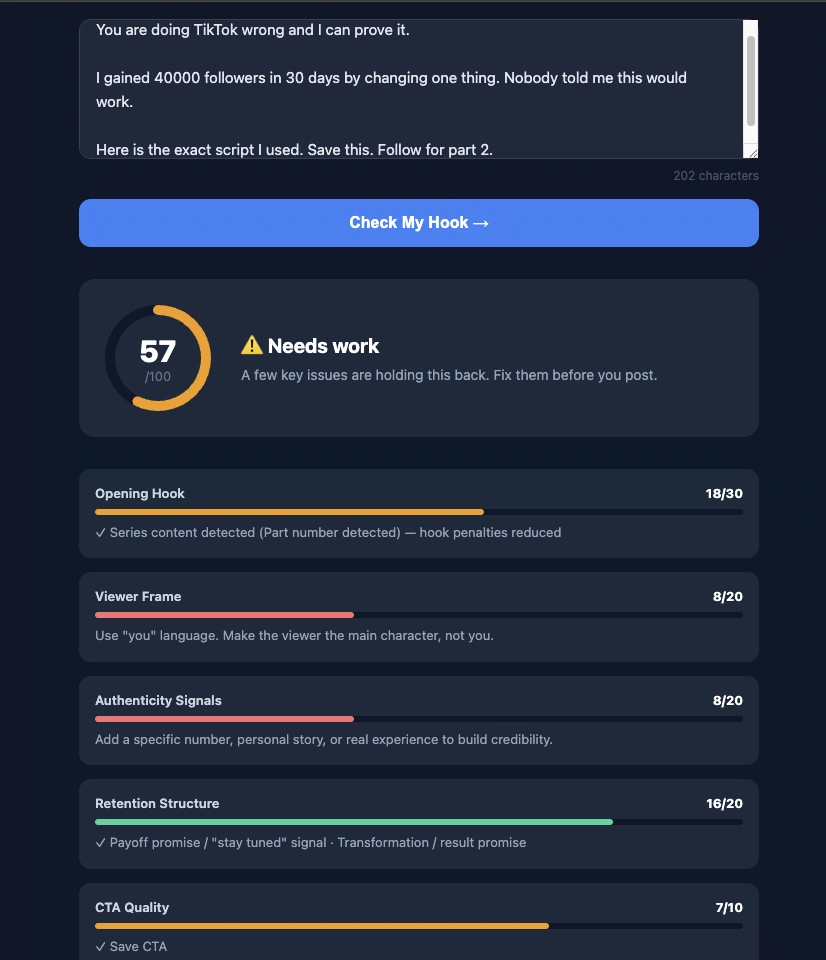
One thing that broke our initial model: series content. "Welcome back to Automating My Life with Python, day 30" scored poorly on hook strength — because we were penalizing "generic openers." But videos with that format routinely hit hundreds of thousands of views.
The reason: series content isn't trying to hook new viewers, it's serving an existing audience. The engagement mechanic is loyalty, not curiosity. Save rate matters more than like rate. Depth and specificity matter more than a compelling opener.
Once we added series detection (looking for "Part X", "Day X of", "Welcome back to", "Episode X"), we stopped penalizing a format that's working exactly as intended.
Practical tip: If you're running a series, don't stress about the hook. Your viewers are already sold. Optimize for depth, specificity, and the "save this" moment — the thing so useful they bookmark it.
The scoring accuracy results
After incorporating all of these findings into a scoring engine, here's where we landed on a 40-post backtest:
| Platform | Before tuning | After tuning |
|---|---|---|
| 80% | 80% ✅ | |
| Instagram captions | 60% | 100% ✅ |
| Instagram Reels | — | 100% ✅ |
| TikTok | 30% | 88% ✅ |
| 30% | ~80% ✅ |
The TikTok jump from 30% to 88% came entirely from switching to transcript-based scoring. The Instagram caption jump from 60% to 100% came from adding spam detection and a content density minimum. LinkedIn was already the most consistent — the platform's native format (storytelling + structured framework + CTA) maps cleanly to rule-based detection.
What this means for your content
Most content fails before anyone reads the caption. The platform decides in the first 3 seconds whether to push your content or bury it — and that decision is based on early engagement signals driven entirely by your hook.
The good news: hooks are learnable. The patterns are specific. The death patterns are avoidable. You don't need to go viral by accident — you can engineer content that has a legitimate shot.
Score your content before you post
We turned everything we learned into a free scoring tool. Paste your caption or video script, pick your platform and industry, get a score out of 100 with specific feedback. No signup required.
Score My Content Free →